check latest hearing aids:
https://www.oticon.com/
https://www.unitron.com/
https://www.resound.com/en/
https://www.bhm-tech.at/en/Products/
Balance Assessments
Videonystagmography is a comprehensive diagnostic procedure that evaluates oculomotor and vestibular function by recording eye movements with infrared video goggles. Patients are asked to follow visual targets, undergo positional changes, and perform specific tasks while eye movements are tracked. The protocol includes several components:
These assess the integrity of central pathways controlling eye movements. Patients perform tasks such as saccades (rapid eye jumps between targets), smooth pursuit (tracking a moving target), and optokinetic testing (following repetitive moving patterns). Abnormalities in these responses may indicate central nervous system involvement rather than peripheral vestibular dysfunction.
Warm and cool air or water is introduced into the ear canal to stimulate the vestibular system, producing predictable nystagmus that helps determine labyrinthine function.
Eye movements are recorded while the patient is placed in different static positions (e.g., supine, head right, head left). These tests identify spontaneous or position-induced nystagmus that may indicate peripheral or central vestibular pathology.
Dynamic maneuvers, such as the Dix-Hallpike test, are performed to provoke nystagmus associated with Benign Paroxysmal Positional Vertigo (BPPV). These tests help localize the affected semicircular canal and confirm the diagnosis.
Together, VNG with oculomotor, caloric, positional, and positioning tests provides a cornerstone evaluation for differentiating peripheral from central causes of dizziness and imbalance, offering clinicians a detailed profile of vestibular system integrity.
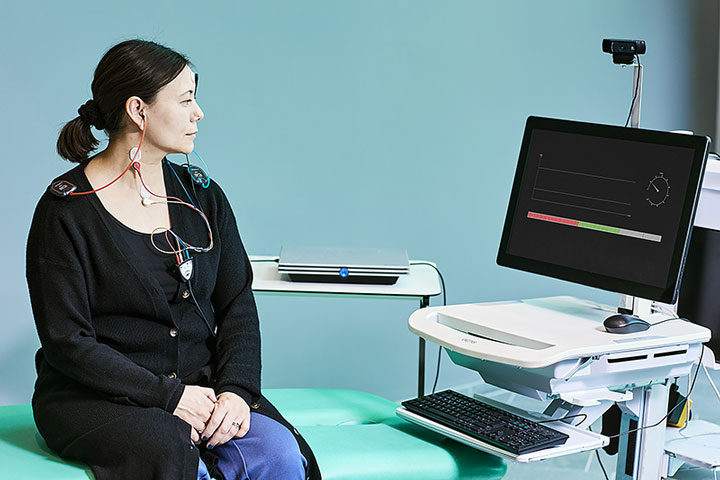
VEMPs measure reflexive muscle responses to acoustic stimulation. Sounds are delivered to the ear while electromyographic activity is recorded from target muscles. There are two clinically recognized types:
Together, cVEMPs and oVEMPs provide complementary information about otolith organ function, which detects gravity and linear acceleration.
The TRV Chair is a specialized diagnostic and therapeutic system for Benign Paroxysmal Positional Vertigo (BPPV). Patients are seated in a motorized chair that rotates and repositions them in three dimensions while eye movements are monitored. The chair confirms the presence and canal location of BPPV and simultaneously provides treatment through controlled repositioning maneuvers, effectively restoring normal vestibular function.